Fun and Educational Games for Family Bonding
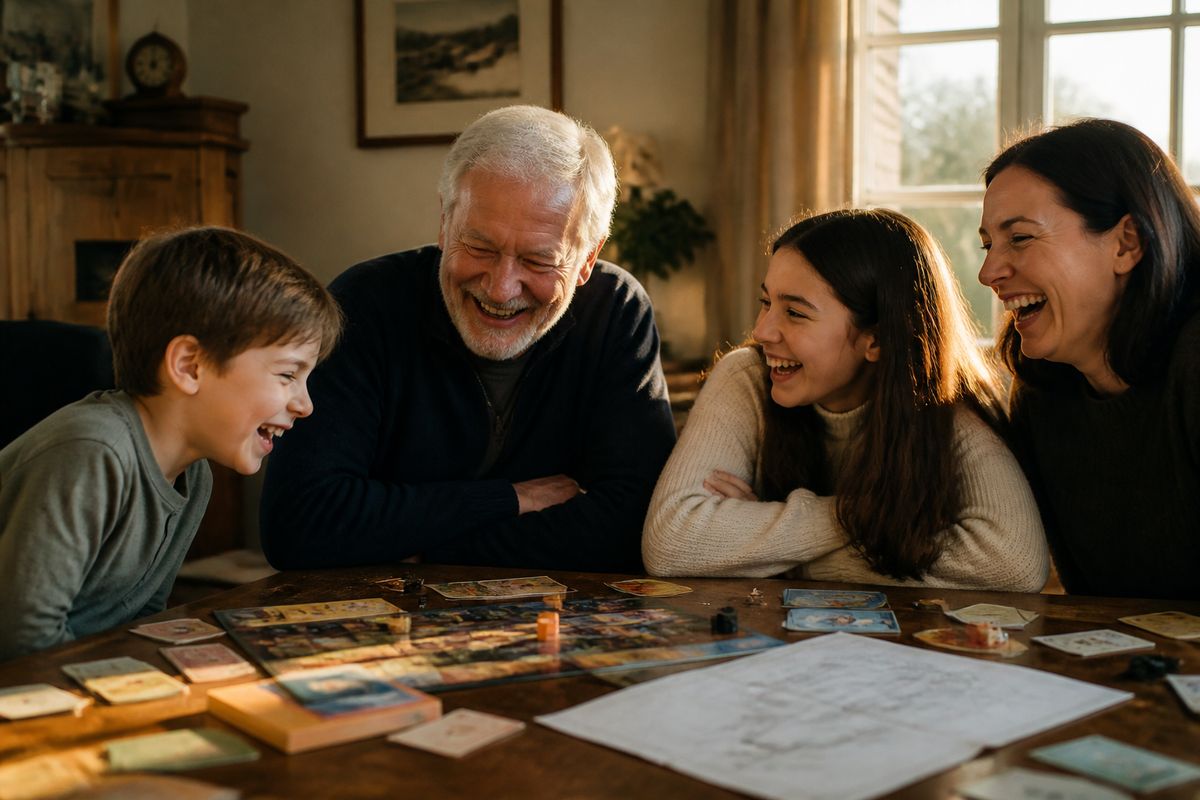
Fun and educational games for family bonding work best when you stop treating "fun" and "educational" as a tradeoff. A good game teaches something, vocabulary, strategy, patience, how to lose gracefully, without anyone noticing they're being taught. Below are games organized by setting (indoor, outdoor, digital, kitchen), what each one actually builds, and how to run it so a 7-year-old and a 14-year-old can both stay interested.
Why games beat "quality time" as a plan
"Let's spend more time together" is a goal nobody can check. "Game night, Friday, 7pm, 45 minutes" either happens or it doesn't. Games also give families something dinner conversation often lacks: a shared task with rules, turns, and a real outcome. The American Academy of Pediatrics' clinical report on play describes it as "brain building" that supports executive function and builds the bond between parent and child, and links regular one-to-one play with reduced stress and disruptive behavior in young children. A randomized study of Spanish schoolchildren ages 6 to 13 found that playing commercial board games produced measurable improvements across executive function domains (planning, attention, self-monitoring) over a several-week period, and notably, the plain, non-gamified version of play worked as well as or better than a version dressed up with points and rewards. The takeaway isn't that Scrabble will raise anyone's IQ. It's that regular, low-pressure game time is doing real cognitive and emotional work, not just filling an hour.
None of this requires new equipment. Most of what follows uses a deck of cards, a notepad, or things already in the house.
Indoor games
1. Scrabble (or a junior version for readers under 8)
Set a 3-minute-per-turn timer so younger or less-confident players don't stall the game while they search for a word. Let anyone under 10 use a rack rest and a simple word list as reference, the goal is participation, not a strict tournament ruleset. Play teams of one strong reader with one early reader if the age gap is wide; the pairing keeps the game moving and turns it into quiet coaching instead of a mismatch.
2. Pictionary
Use a 60-second sand timer, not a phone timer, phones invite someone to check messages mid-round. Write your own clue cards split by difficulty (easy: "dog," "pizza"; hard: "jealousy," "democracy") so you can hand harder cards to teens and adults and easier ones to younger kids without anyone feeling singled out.
3. Trivia, built from your own family
Store-bought trivia (Trivial Pursuit, a quiz app) works, but a homemade round beats it for engagement: each person writes 5 questions about a subject they actually know (a teenager's favorite show, a parent's college major, a grandparent's hometown). It turns trivia night into a chance to learn actual facts about each other, not just recall generic pop-culture answers.
4. Kitchen-table science
Pick one experiment with a clear before/after so kids can predict an outcome before testing it: baking-soda-and-vinegar eruptions, a homemade lava lamp (oil, water, food coloring, an Alka-Seltzer tablet), or a simple density tower with honey, dish soap, water, and oil. Budget 20 to 30 minutes including cleanup, and have the kids state their prediction out loud before you start, that one step is what turns a mess into an actual experiment.
5. A DIY escape room
Hide 4 to 6 clues around one or two rooms, each unlocking the next (a riddle taped under a chair leads to a number that opens a lockbox with the next clue, and so on). Cap the whole thing at 30 minutes for kids under 10, interest drops off fast past that point. Test the chain yourself beforehand; a broken clue chain is the single most common way these fall apart.
Outdoor games
6. Scavenger hunt
A list of 10 to 15 items works better than an open-ended "find cool stuff" hunt because it gives kids a finish line. Mix easy finds (a pinecone, something red) with a couple that require real looking (an insect, a bird's nest) so both younger and older kids have something to contribute.
7. Nature bingo
Make a 4x4 grid with a mix of plants, bugs, and birds common to your area and season, check a local nature center or extension office site if you're not sure what's realistic to spot. This keeps the game winnable instead of frustrating.
8. Charades
Split categories by age: movies and books for the whole family, but let teens and adults draw a "historical figure or event" deck separately from a younger kids' "animals and jobs" deck. One shared deck usually means younger kids get stuck acting out things they've never heard of.
9. Capture the flag
Needs at least 6 players and a clearly bounded space (a backyard with two visible ends, or a section of a park). Agree on tag rules and out-of-bounds lines before starting, the most common way this game turns into an argument is a disputed boundary call mid-play.
Crafting and storytelling games
10. Story cubes
Roll 3 dice (image-based story dice, or make your own from a blank cube and stickers) and build a story together, one sentence per person, incorporating whatever image comes up next. Works for a wide age range because there's no wrong answer, a 6-year-old's contribution counts as much as an adult's.
11. Themed art night
Pick one prompt per session instead of open-ended "make some art" (which tends to stall out for kids who don't already draw). "Draw your favorite memory from this year" or "design a flag for our family" gives everyone a starting point and produces something worth keeping afterward.
Digital learning games (used deliberately, not as a babysitter)
12. Co-played educational apps
PBS Kids and Khan Academy Kids are free and ad-light, and both work better as a shared activity than a solo one, sit with younger kids while they play so it's a conversation, not just a screen handoff. The American Academy of Pediatrics' current guidance moves away from strict hour limits and instead emphasizes the quality and context of screen use, watching or playing together, and talking about what you're seeing, matters more than the number on the clock.
13. Virtual museum tours
The Smithsonian and several major museums post free virtual collections online. Pick 3 to 5 pieces in advance rather than browsing live with kids in the room, an unstructured tour loses attention fast. Ask each person to pick a favorite and say why; that one question does most of the work of turning a tour into a conversation.
Kitchen challenges
14. A mini cooking challenge
Give each person or team a fixed set of ingredients (a protein, a starch, two vegetables, one "mystery" item) and 45 minutes to build a dish. Keep knife use age-appropriate and supervised, and taste everything at the table together afterward instead of judging silently, the conversation about what worked is most of the value.
Running a game night that actually keeps happening
- Put it on the calendar with a fixed day and time. "Whenever we're free" is how game night quietly stops happening.
- Rotate who picks the game. If one parent always chooses, it starts to feel like an assignment instead of something the whole family owns.
- Keep the first few sessions short. 30 to 45 minutes is easier to stick with than an open-ended two-hour block, especially with younger kids.
- Retire a game that's gone stale. If everyone's checked out, swap it rather than forcing the schedule for its own sake.
FAQ
What age is too young for family game night?
Most cooperative games (story cubes, simple scavenger hunts, matching games) work from around age 4, as long as the format doesn't require reading or long turns. Competitive strategy games usually land better starting around 7 or 8.
How often should families do this to see a real difference?
Weekly is a realistic, sustainable target for most households. The research on board games and executive function used sessions spread over several weeks, not a single one-off night, consistency is doing more work than any individual game.
Do educational games actually help with schoolwork, or is that a stretch?
They can reinforce specific skills, vocabulary, arithmetic, sequencing, planning ahead, especially when a game maps closely to what's being taught (Scrabble and spelling, for instance). They're a supplement to schoolwork, not a replacement for it.
What if one kid always wants to win and ruins the mood?
Pick at least one cooperative game (story cubes, an escape room, a scavenger hunt with a shared list) for nights when competitiveness is running high. Save head-to-head games for when everyone's actually in the mood for them.